
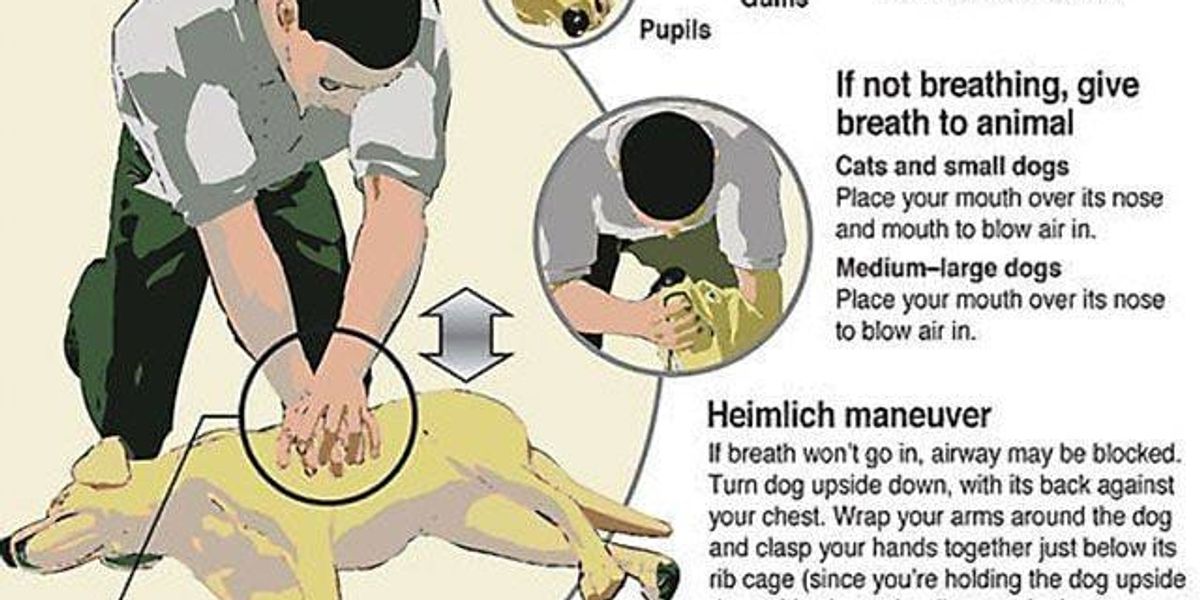
Saving your pet with CPR
With pets increasingly being treated like a member of the family, many owners are learning emergency techniques like CPR to keep their pet alive before bringing it to a veterinarian. If there is no breathing and no pulse, begin CPR immediately.
Check for breathing and pulse: check pulse using middle and index finger below the wrist, inner thigh (femoral artery), below the ankle or where the left elbow touches the chest.
Look for other warning signs: gums and lips will appear gray-colored; pupils will be dilated and not responsive to light.
If not breathing, give breath to animal. Cats and small dogs: place your mouth over its nose and mouth to blow air in. Medium-large dogs: place your mouth over its nose to blow air in.
Heimlich maneuver: if breath won't go in, the airway may be blocked. Turn the dog upside down, with its back against your chest. Wrap your arms around the dog and clasp your hands together just below its rib cage. Using both arms, give five sharp thrusts to the abdomen. Then check its mouth or airway for the object; if you see it, remove it and give two more rescue breaths.
Start compressions if no pulse: lay the animal on its right side and place your hand over the ribs where its elbow touches the chest. Do not give compressions if the dog has a pulse.
Compressions: cat/small dog (under 30 lbs) — compress chest 1/2–1 inch, 5 compressions per breath. Medium-large dog (30–90 lbs) — 1–3 inches, 5 compressions per breath. Giant dog (over 90 lbs) — 1–3 inches, 10 compressions per breath.
Repeat: check pulse after 1 minute and then every few minutes. Continue CPR until the animal has a pulse and is breathing. Stop after 20 minutes.